How 3D printing has revolutionized the design and production of vacuum grippers: the Kenos case study
Kenos' journey with industrial 3D printing has made it possible, thanks to the support of 3DZ, to reduce time and costs, optimize design, and develop innovative and lightweight vacuum gripping systems.
Part of the international Piab Group, Kenos Srl is a leading company in the design and manufacture of vacuum grippers for large surfaces.
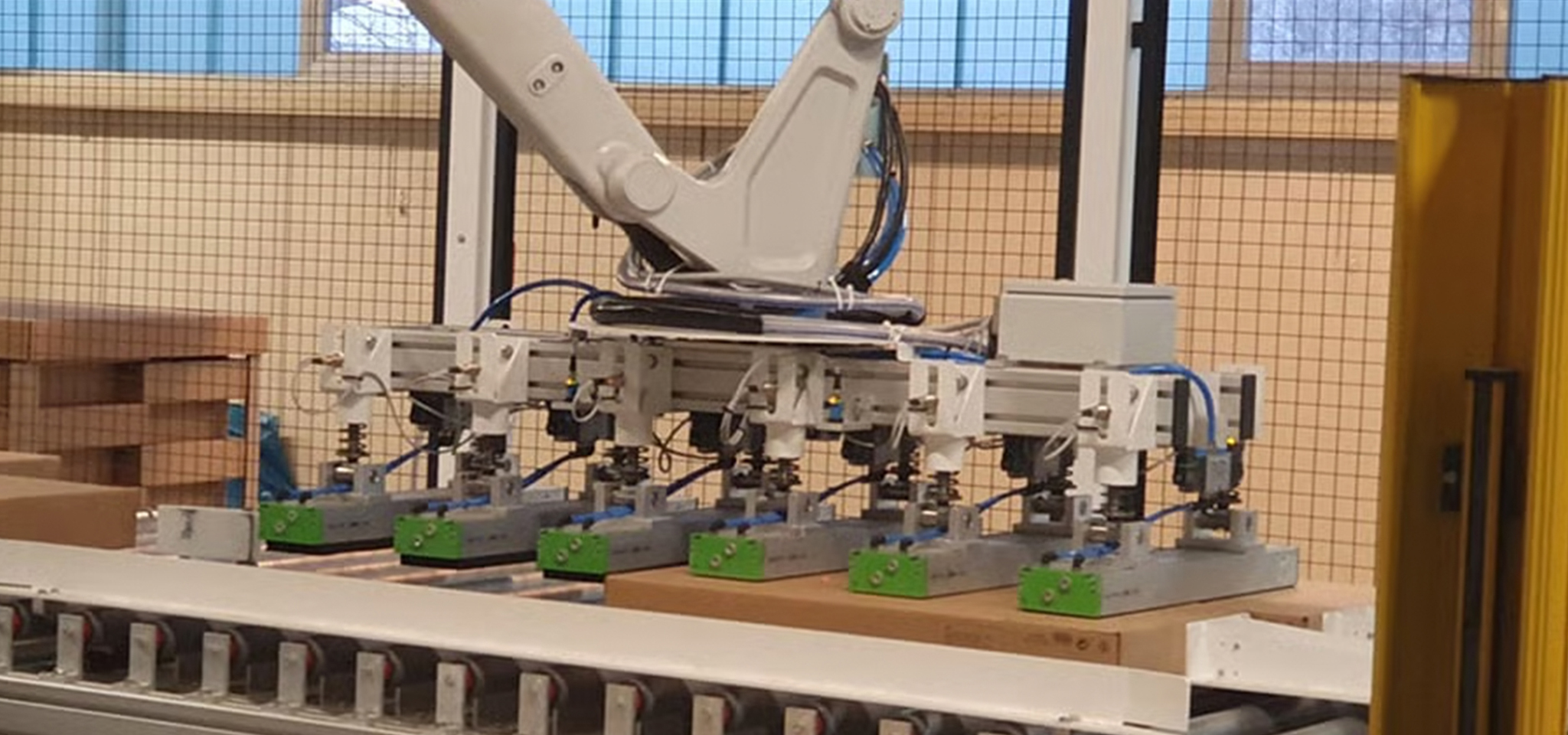
Kenos systems are used in various industrial sectors: from timber, with its dirty working conditions that are difficult to replicate in CAD, to glass and plastic, to packaging and food, where precision and lightness are essential. The product range includes solutions for handling objects of different sizes and shapes, with or without integrated vacuum generation.
The need
How can you achieve greater flexibility and reduce development times?
As applications evolved, Kenos had to deal with increasingly stringent customer requirements. While solutions were mainly standard in the early days, today’s market demands special gripping systems, often one-off projects that have to work first time and within tight deadlines.
Using only traditional mechanical processes (milling/turning), the company faced a number of limitations:
long prototyping times (up to a week for the first piece), which slowed down research and development and time-to-market;
high costs for each iteration, with the risk of starting from scratch in case of failure;
difficulty in lightening the weight: even with aluminum, the weight was not always compatible with high-frequency robotic cycles.
The variability of the sectors served, from wood (dirty environment, dimensional variability) to food and packaging (high cadence, precision), required versatile, robust, and quickly testable solutions.
Kenos therefore had three fundamental needs:
1
Discovering new geometric freedoms
By breaking free from the limitations of classical mechanics, Kenos was able to design gripping systems with complex internal geometries and integrated vacuum ducts, which would have been impossible to achieve using traditional manufacturing methods.
3D printing made it possible to incorporate threaded inserts, housings, and suction chambers into a single body, reducing the number of components and simplifying assembly.
2
Drastically reduce prototyping times
The introduction of 3D printing has transformed the development process: from design to part validation now takes less than 24 hours.
This has allowed the Kenos team to test multiple variants on the same day, optimizing gripper performance and significantly accelerating the research and development of new products.
3
Manufacturing lightweight, optimized components
Thanks to the use of materials such as carbon fiber and PA12 nylon, Kenos has achieved grippers that are 50% lighter than aluminum versions, but with the same rigidity and strength.
This weight reduction allows collaborative and delta robots to operate at faster cycles, improving energy efficiency and reducing wear on mechanical parts.
Speed, lightness, and new geometries with 3D printing
Kenos’ journey with industrial 3D printing began in 2023, thanks to the support of 3DZ, with two professional desktop systems:
Markforged Mark Two (filament technology with continuous fiber reinforcement: carbon, glass, Kevlar) for structural components with high rigidity and specific strength;
Formlabs Form 3+ (SLA) for precision resin parts with fine details and tight tolerances
This phase allowed us to map out use cases: the Mark Two for load-bearing elements and lightweight frames; the Form 3+ for components with critical seats, interfaces, and finishes.
A concrete example concerns a gripper for pet food bags at 120 cycles/min on a Delta robot for an Italian customer: (a body weighing less than 1 kg was needed that integrated valves, a vacuum generator, stabilizers, and a flange. With traditional methods, the all-in-one solution was not feasible; with 3D printing, however, it was achieved by combining reinforced structures (Markforged printer) and precision parts (Formlabs printer).
In 2024, Kenos also introduced, through 3DZ, two Formlabs Fuse 1+ powder SLS systems with a Fuse Blast post-processing unit, the automated system for cleaning and finishing SLS parts, enabling the transition to the production of standard components. With stable and repeatable materials such as PA12/PA11, it was possible to retrofit existing aluminum components and design new parts with internal suction chambers, integrated ducts, and topological lightening, overcoming the limitations of subtractive manufacturing.
“We identified 3D printing because it is very well suited to the specials sector. It's not just about moving boxes, but also more complex objects. Today I design, tomorrow I print and test. If it's not right, I reprint immediately at a much lower cost.”
Francesco Faienza
Designer
The advantages of 3D printing for Kenos
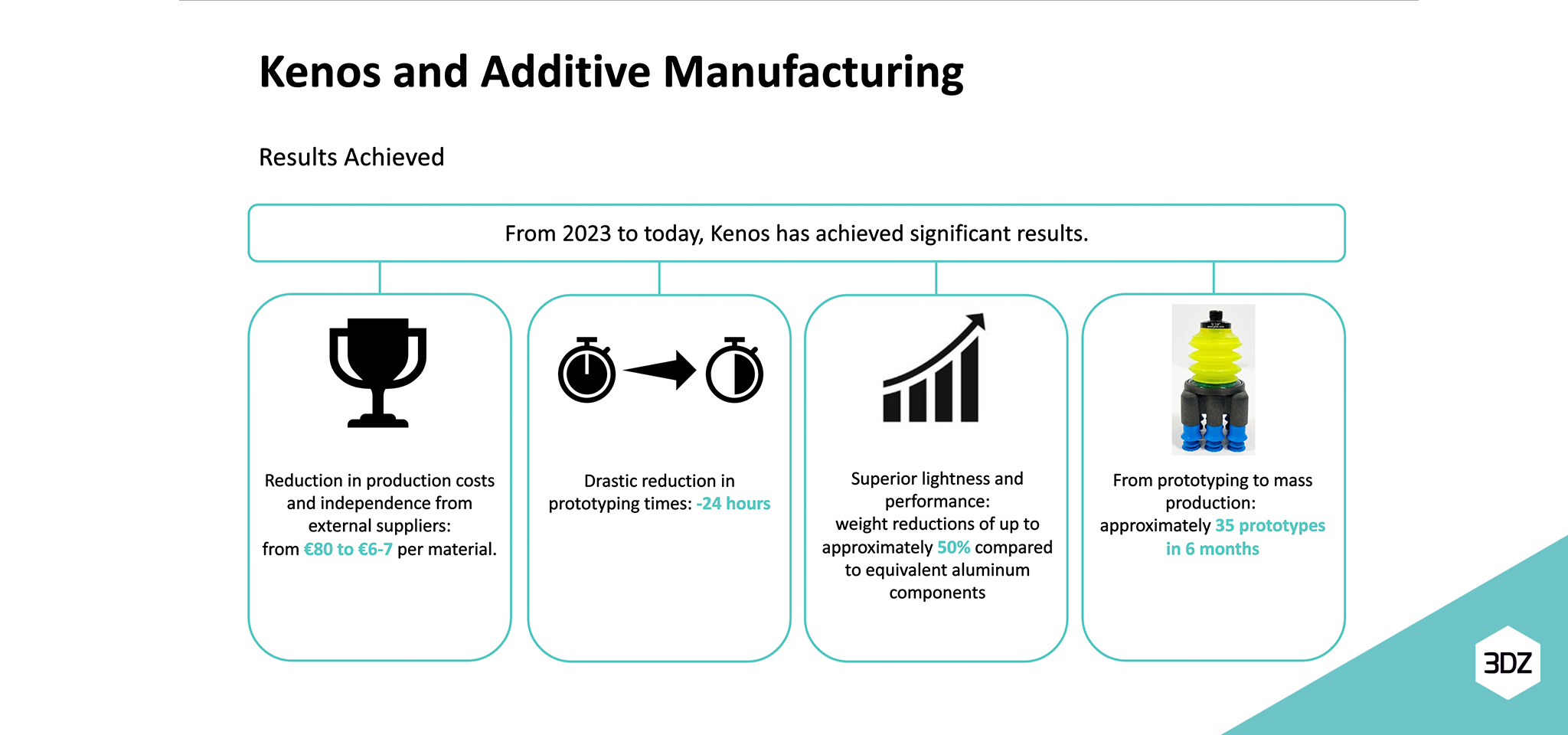
Drastic reduction in prototyping times
A cycle that previously took a week now takes less than 24 hours. The designer models in CAD, sends the file to the printer, and tests the prototype the next day. If an adjustment is needed, printing is restarted on the same day. In addition, for many tests, only the critical portion is printed (e.g., the interface with the element to be manipulated), avoiding the need to redo the entire piece. This allows for more iterations on the same day, with rapid feedback and informed decisions.
Reduction in production costs and independence from external suppliers
A component that used to cost around €80 from an external supplier is now produced in-house with €6–7 worth of materials. In addition to the savings per unit, there are also process savings: less waste, less rework, and less dependence on subcontractors. The result: cost control, more stable margins, and greater autonomy in dealing with production emergencies.
Superior lightness and performance
The molded structures (internal lattices, functional cavities) allow for weight reductions of up to approximately 50% compared to equivalent aluminum components. On collaborative and delta robots, this means faster cycles, lower inertia, reduced stress on joints and motors, and, in many cases, lower energy consumption. The integration of multiple parts into the same body reduces assemblies, screws, and gaskets, increasing reliability and the Mean Time Between Failures (MTBF) of the gripper unit.
From prototyping to mass production
After a year of experimentation, Kenos has industrialized 3D printing on standard products and retrofits of components historically made of aluminum. For the new gripper, the heart of the system has been completely redesigned using additive manufacturing: around 35 prototypes in six months have led to a stable and repeatable version, ready for mass production, with development times and costs reduced by around ten times compared to the traditional process.
“Contrary to popular belief, 3D printing is repeatable and reliable.” Francesco Faienza – Designer.
The advantages of 3D printing for Kenos
Design freedom and new geometries
With 3D printing, internal vacuum chambers, optimized ducts, and seats for threaded inserts become standard. Kenos was able to test different insertion techniques, hot insertion, hexagonal nuts, and square nuts incorporated, on the same day, choosing the best solution for loads, cycles, and maintenance each time. The result is more compact and maintainable grippers, with fewer leak points and better vacuum efficiency.
Innovation perceived by the market
The combination of fast turnaround times, advanced geometries, and performance has a direct impact on the end customer’s perception: more modern, reliable solutions with tangible ROI. This strengthens Kenos’ positioning as a technology partner and accelerates commercial cycles.
Organizational impact and team autonomy
The convergence between design and production allowed the team of designers and technicians to independently manage the fine-tuning of components, postponing the addition of resources dedicated exclusively to production. The shortened flow (CAD → printing → testing) created a fast track for research and development, while maintaining production capacity available for growing batches.
“With 3D printing, we have achieved lighter solutions, reduced costs and times, and optimized design. This is a plus that our customers perceive as innovative, and they also appreciate the reliability of the machines and the speed with which we are able to provide new solutions.”
Francesco Faienza
Designer
The role of 3DZ
In adopting 3D printing, Kenos collaborated with 3DZ to gradually integrate new technologies into its processes. This collaboration developed through various activities, including:
Analysis of application requirements: mapping use cases (special vs. standard), cycle requirements (up to 120 bpm), weight limits, vacuum and pneumatic interfaces.
Choice of technology/material: reinforced filament technology for structural parts, SLA for precision, SLS (PA12/PA11) for standard production with stability and repeatability.
Consultancy on design for 3D printing: practical guidance on the best design strategies to make the most of additive technologies, with suggestions on geometries, thicknesses, function integration, and material selection.
Optimization of digital workflow and quality control: setting up the digital path (preparation, SLS nesting, parameters, post-processing), dimensional and functional checks on the first batches, traceability of revisions.
Operational training: team training to make designers and technicians autonomous in file preparation, setup, maintenance, and post-processing.
Ongoing application support: assistance during critical phases (choice of inserts, seals, coupling tolerances), right up to the start of production of the parts.
Technical assistance: constant presence both during the sales phase and thereafter, with timely support in resolving issues and managing the machines.
“The journey with 3D printing started from scratch: first experimentation, then validation, and finally direct production. Along the way, the support we received from 3DZ was essential in understanding how to best integrate the technologies and exploit their full potential. The machines they sold us are reliable, and 3DZ's customer service is great. I write to them, and they respond within an hour.”
Francesco Faienza
Designer
In summary
Kenos’ experience demonstrates how industrial 3D printing is no longer just a prototyping tool, but a real driver of industrial transformation.
Thanks to the support of 3DZ and Markforged and Formlabs SLA and SLS technologies, the company has been able to:
reduce time and costs by up to 10 times;
optimize processes;
reduce design limitations;
lighten grippers and launch innovative standard products on the market.
The future prospects are ambitious: by 2026-2027, Kenos aims to build a 90 m² 3D room in Padua and become the research and development center for 3D production for the entire Piab group.